Wall Street rushes to mimic crypto's playbook on Capitol Hill
Published in Business News
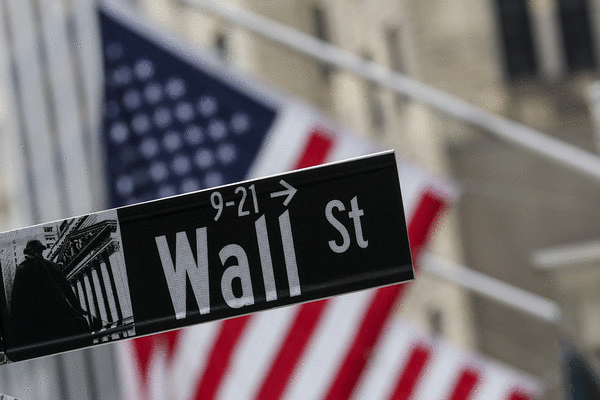
Wall Street executives were repeatedly stunned by the cryptocurrency industry’s newfound political dominance in the wake of the 2024 elections.
Now, they’re ramping up their own spending with a strategy resembling the crypto sector’s tactics.
Late last year, the Financial Services Forum, an advocacy organization representing the eight biggest US banks, formed a trio of groups to spend tens of millions of dollars on the upcoming midterm elections and beyond.
The format mirrors the crypto industry’s approach with an entity that funds two separate groups, one on each side of the political aisle. Fairshake, a crypto organization, grew into the largest single-issue super PAC in history during the 2024 election cycle. The banks opted for 501(c)(4)s, advocacy nonprofits often called “dark money” groups that are allowed to spend nearly half of their budgets on influencing elections.
The banks’ American Growth Alliance, which funds center-left Opportunity Forward Alliance and conservative Alliance for Economic Freedom, has raised about $100 million for this cycle so far, according to a person familiar with the matter, who asked not to be named discussing non-public information. The groups have already deployed millions, including on advertisements in half a dozen states that will begin airing later this year.
“Since the financial crisis really, the banks have been debating: Do they aggressively go out and defend themselves, or do they sit back?” Bill Daley, a veteran of Washington and Wall Street, said in an interview. “I believe they’ve crossed that Rubicon now to make that decision: ‘We’ve got to play.’ ”
In an emailed statement, the American Growth Alliance said it was created to raise awareness about economic and financial issues, such as job creation and affordability.
“The AGA has a bipartisan agenda, supporting leaders who advance the commonsense policies that will benefit all of America’s hard-working families,” the group said.
After the 2008 financial crisis when big banks became the subject of bipartisan ire, Wall Street firms took a quieter approach to lobbying in Washington. But that started to shift in 2023, when regulators proposed higher capital rules called “Basel III Endgame,” prompting banks to fight back with their fiercest lobbying campaign in history.
Around the same time, Coinbase Global Inc. Chief Executive Officer Brian Armstrong, who is worth $8 billion according to the Bloomberg Billionaires Index, was making plans for the crypto industry to gain power in Washington. Coinbase became the biggest donor to Fairshake, which, with the help of two affiliated super PACs called Protect Progress and Defend American Jobs, spent $135 million across dozens of candidates during the 2024 election cycle.
Now, more than two dozen of those individuals sit on congressional committees that oversee the crypto industry and have pursued multiple pieces of legislation around digital assets over the past year.
Take Senator Bernie Moreno: the Republican from Ohio got more than $40 million in support from the crypto lobby in the 2024 cycle. The blockchain entrepreneur defeated Sherrod Brown, a crypto skeptic who was chairman of the Senate Banking Committee, in what Fairshake identified as one of its priority races.
That spending has proven advantageous for crypto in a dispute with the banks this year over a digital asset bill that addresses, among other things, stablecoin yields. The so-called Genius Act, which President Donald Trump signed into law last summer, prohibited primary issuers from paying interest on stablecoins. But it left the issue of whether exchanges, of which the largest in the US is Coinbase, can pay interest on stablecoins up to the next piece of legislation, the so-called Clarity Act.
Yields on stablecoins have been a key point of contention. For crypto companies, offering a product with returns can be a lucrative pitch to consumers. But banks have argued that they amount to high-yielding deposits, without the same safeguards and regulations in place for many institutions that hold people’s money.
The fight over that legislation has been full of twists and turns. At one point, Senator Tim Scott, who leads the banking committee as chairman, called senior executives at banks, asking them to hear Armstrong out, according to people familiar with the matter. Representatives from both industries attended closed-door meetings at the White House with no phones allowed. Trump himself has even weighed in on social media.
But in May, the Senate Banking Committee advanced the Clarity Act. The legislation included something of a compromise on the issue — it still allows for certain activity-based rewards, but won’t allow crypto companies to pay returns on idle balances in a nod to banks worried about deposit flight. Bank lobbying groups immediately said the bill “falls short.”
That battle is poised to continue as the bill makes it way through the Senate and then the House. In the meantime, the banks continue to make their case, including via their three new lobbying organizations.
Midterm spending tends to accelerate in late summer or early fall, once the primaries are over and voters begin to think in earnest about the upcoming election.
But already, Opportunity Forward Alliance has sent $3.1 million to New Democrat Majority, a super PAC backing business-friendly candidates on the left. It’s also committed $1.6 million to advertisements in Oregon and Texas related to economic issues, which will start airing in July, according to AdImpact.
The Alliance for Economic Freedom, meanwhile, has committed $2.6 million toward ads backing incumbent Republican candidates in Michigan, Wisconsin, New York and Iowa, all of whom sit on the House Financial Services Committee. Sometimes the banks’ spending is on the same side as crypto’s, like their mutual support of Wisconsin Republican Congressman Bryan Steil.
Meanwhile, the crypto industry is already making its mark in the midterms. Five super PACs supporting its agenda have spent more than $57 million in the current cycle to influence 36 House and nine Senate contests, Federal Election Commission filings show. Fairshake and its affiliates remain the biggest players, accounting for $54 million of that amount. Through April, the super PACs collectively had $167 million cash on hand.
(With assistance from Bill Allison.)
©2026 Bloomberg L.P. Visit bloomberg.com. Distributed by Tribune Content Agency, LLC.






Comments