Colorado activist convicted of doxxing Denver police commander in first-of-its-kind case
Published in News & Features
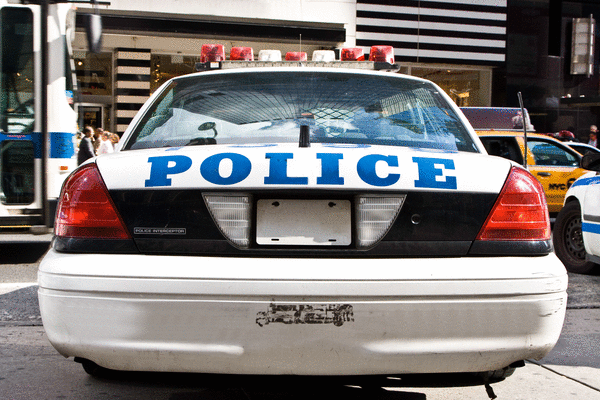
DENVER — A Colorado community activist was convicted of doxxing a Denver police commander last week in a first-of-its-kind case that has fueled debate about whether the state’s online privacy laws violate free speech rights.
A jury in Denver County Court found Regan Benson, 53, guilty of sharing the personal information of a protected person online after she repeated a Denver police commander’s home address during a livestreamed protest and suggested her followers should meet up there so they could “have a pig roast party,” according to an arrest affidavit.
State law prohibits a person from sharing the personal information of police officers online if the person knows that doing so “poses an imminent and serious threat” to the safety of officers or their families. The law protecting police officers’ information has been on the books for more than two decades, but drew renewed attention in 2021 and 2022 when legislators expanded the doxxing protections to other professions, including health care workers, animal control officers and code enforcement officers.
Benson appears to be the first person in the state convicted under the anti-doxxing statute, said Jamie Hubbard, her attorney. She and Benson believe the criminal prosecution was unconstitutional retaliation for her criticism of the Denver Police Department, including a lawsuit she had filed in June.
The misdemeanor conviction can be punished with up to a year in jail.
“This commander didn’t like that she was someone who spoke out critically about the police, didn’t like that she sued,” Hubbard said. “So he sees this opportunity to retaliate against her, and he took it.”
Denver police spokesman Sean Towle declined to comment on the case and said Commander Joel Bell had declined to comment as well. Denver District Attorney John Walsh said in a statement that Benson committed a crime, and Denver jurors recognized that.
“We vigorously support all Coloradans’ First Amendment expression, but, as the jury found, the defendant’s conduct in this case stepped across the line,” he said in the statement.
Benson and Hubbard are not the only ones questioning the validity of the law — the statute is also facing a constitutional challenge in U.S. District Court for the District of Colorado in a separate federal lawsuit in which a Colorado state trooper accused a process server of violating the anti-doxxing law by including the trooper’s home address in a court filing.
“These are the types of laws that proponents can make sound good when they march them through the legislature, but which 100% of the time get repurposed to the suppression of people’s constitutional rights,” said Adam Frank, a civil rights attorney not involved in either case.
Benson made her “pig roast” comments on Sept. 3 at the District 3 Police Station at 1625 S. University Blvd. Benson was livestreaming her protest at the police station when she asked her followers to look up Bell’s home address so they could host a pig roast there. They obliged, finding an address in Centennial. Benson repeated the address and then reiterated her suggestion on the livestream.
“I just wanted to advertise a big party at a pig house. Pigs get together and do pig party stuff,” she said, according to the publicly available affidavit, which includes Bell’s home address and notes that “pig” is a derogatory slang term for a police officer.
In an interview Thursday, Benson said the idea was not serious.
“It was a complete and total joke,” she said. “That’s what roasts are. Parodies, comedies, satire, sarcasm, hyperbole. That is exactly what that was.”
But at trial, Bell testified about how Benson’s words made him feel, Hubbard said. CBS Colorado, which first reported the case, said Bell established a safety plan that included increased patrols around his home and the installation of a security camera.
“It is tough for a jury who sits in a courtroom and listens to someone testify about their fears, fears for their family, how they were emotionally impacted by what someone else said,” Hubbard said. “It’s hard for a jury to set that aside and think, ‘Well, that is what the First Amendment is for.'”
Benson will appeal after she is sentenced on May 8, Hubbard said. In the meantime, Benson said she is losing sleep and spending a significant amount of money on the case.
“They’re definitely achieving the goal of chilling my speech, because I am consumed now with every word coming out of my mouth being taken out of context in public settings,” she said, adding that she recently decided not to attend a police community meeting as she typically would have. “I was going to go, and at the last minute, I said to myself, ‘You can’t. They’re successful at getting you prosecuted over lies.'”
Colorado lawmakers expanded the anti-doxxing law after the COVID-19 pandemic, when a number of professionals, particularly in health care, experienced increased harassment. Lawmakers pitched the protections as a way to shield professionals in public service roles from threats.
“As well-intentioned as the law might have been, it has clearly been bastardized and used in a way that violates some pretty fundamental constitutional rights,” said Andy McNulty, an attorney who has represented Benson in past lawsuits.
Three federal courts have found that citizens have a right to publicly identify police officers; attempts to restrict that kind of speech have been found unconstitutional in Washington, Florida and California, said Jason Kennedy, the attorney who is challenging Colorado’s law in federal court.
“Rather (than) proscribing statements that are intended by the speaker to be threatening, the statute criminalizes speech when the speaker ‘reasonably should know’ of a threat posed by others,” Kennedy said. “That is a rather broad and vague standard, and the General Assembly exceeded the limits of its police powers in violation of the First Amendment.”
In that case, Andrew Scott, a professional process server, sought to serve a subpoena from the Colorado Department of Revenue on Charles Hiller, a state trooper, in 2021, according to court records. When he could not connect with Hiller, Scott completed an affidavit of service refusal in which he described his efforts to serve the subpoena and included Hiller’s home address, among other information.
Hiller then pursued professional complaints against Scott on the grounds that the affidavit violated the state’s anti-doxxing law. Scott was never criminally charged, but later sued El Paso County District Attorney Michael Allen over the law.
Scott alleged in the lawsuit that he wanted to create a website dedicated to showing police officer misconduct — including posting video showing his efforts to serve the subpoena on Hiller that included some of the trooper’s personal information — but that he was afraid to do so because he might face criminal prosecution under the state’s anti-doxxing law, according to case filings. He sought a declaration that the law was unconstitutional.
Senior Assistant County Attorney Bryan Schmid argued in court filings that Scott failed to show the law is unconstitutional and suggested that Scott could create his website and post his videos with redactions to hide the personal information in the clips.
“Certainly, even with the personal information blurred and/or redacted from the video and affidavit of service, enough information or dialogue would remain to prove his version of the facts and provide him with the vindication he so desperately wants,” Schmid wrote.
In Scott’s case, the two sides are awaiting the judge’s final ruling on the constitutional issues.
©2026 MediaNews Group, Inc. Visit at denverpost.com. Distributed by Tribune Content Agency, LLC.





Comments