Fundraiser for Illinois GOP governor candidate Darren Bailey delayed after Tribune raised ethics law questions
Published in News & Features
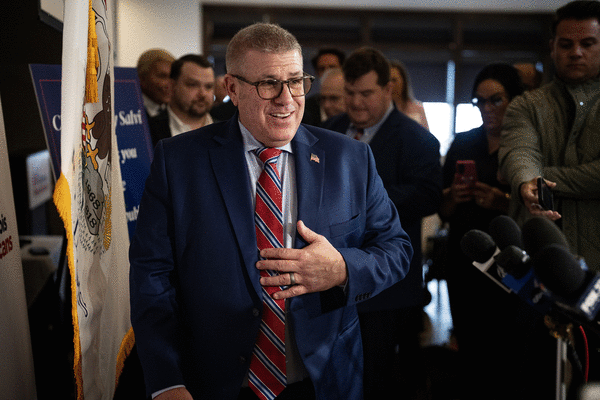
A political dinner that had been scheduled for Thursday in the northwest suburbs to benefit Republican governor candidate Darren Bailey was postponed after the Tribune raised questions about whether the event complied with a 4-year-old Illinois law prohibiting candidates from holding fundraisers anywhere in the state when the legislature is in session in Springfield.
Bailey campaign spokesman Jose Durbin said in a text message Wednesday that the event would be rescheduled “for a later date.” As a state senator in 2021, Bailey voted in favor of the law. The Illinois General Assembly is scheduled to be in session through at least Sunday.
The Barrington Township Republican Organization had invited supporters in an online advertisement to “a very private dinner” Thursday at a South Barrington restaurant with Bailey and running mate Aaron Del Mar. The $500-per-plate dinner, limited to 25 seats, would be “paid for by the BTRO with all NET proceeds from dinner benefiting Bailey for Illinois,” according to a digital flyer featuring pictures of the candidates and their campaign logo.
That fine print raised questions about whether the event would have violated a 2022 state law barring statewide elected officials such as the governor, attorney general or secretary of state, members of the General Assembly, or any candidate for those offices from holding “a political fundraising function on any day the legislature is in session or the day immediately prior to such day.” The prohibition also applies to “any political committee on behalf of” those elected officials or candidates. But it’s unclear who is ultimately responsible for policing any potential violations.
Terry Yormark II, chairman of the Barrington Township Republican Organization, told the Tribune on Tuesday he was unaware of the law until a reporter contacted him, but he said he did not think the restriction would apply because his organization is “not a committee on behalf of a candidate.”
Payments collected would be recorded as contributions to the Barrington Township group, not Bailey’s campaign fund, he said.
Like any other township GOP organization, “we support any qualified Republican candidate for office,” Yormark said.
Nevertheless, Yormark confirmed in a text message Wednesday that the dinner would be postponed, despite an additional review by the group’s attorneys “confirming their opinion there is no conflict with a township organization hosting a fundraising dinner.”
“Compliance is obviously top priority and something BTRO refuses to sacrifice,” Yormark wrote. “If there is even a 1% chance some opposing attorney disagrees, it isn’t something worth fighting over. Our state has much bigger issues to focus on.”
Advertising that proceeds from an event would be routed to a specific campaign committee that would itself be prohibited from holding a fundraiser is, at best, a legal gray area, state campaign finance and election law experts told the Tribune.
“If they had just gone ahead and held a fundraising function that day with Bailey as the guest speaker,” that would be “clearly OK,” said veteran election attorney Michael Dorf, whose clients have included the Democratic Party of Illinois.
“The question is, if they say out loud that all the money they’re raising is going to a gubernatorial candidate, do they … then become ‘a political committee on behalf of’ (that candidate)?” Dorf said.
Dorf said he would advise his own clients against using such a fundraising arrangement, “or at the very least, not to say everything is going to go to the governor candidate.”
For Kent Redfield, an emeritus professor of political science at the University of Illinois Springfield who helped craft earlier state campaign finance laws, the issue is even more straightforward, based on his “plain language interpretation” of the 2022 law.
“The township committee is holding an event on a legislative session day with the clear intention to raise money for Bailey’s campaign committee in support of his campaign for governor and therefore is in violation of the section of the state ethics act” that prohibits such events, Redfield said.
The ban was passed as part of a broad overhaul of state government ethics laws in 2021 that was widely panned by good-government groups. It expanded an earlier prohibition on fundraisers in Sangamon County, home to the state capital, when lawmakers were in session, a policy aimed at limiting the potential use of campaign contributions to exert undue influence at the Capitol.
“Maybe the optics of having a Republican township committee event in South Barrington on a session day in Springfield are not as bad as a breakfast fundraiser in Springfield before a morning committee meeting at the statehouse,” Redfield said, “but the law is the law.”
While the phrase “political committee on behalf of” received some attention on the House floor before the ethics package was approved in 2021, the debate focused on whether the ban on session-day fundraisers would apply to the campaign committees of onetime lawmakers who were working in Gov. JB Pritzker’s administration. That included then-Deputy Gov. Christian Mitchell, a former state representative who is now the Democratic nominee for lieutenant governor.
State election officials, however, haven’t made any definitive determination on what qualifies as a “political committee on behalf of” a candidate. “The State Board of Elections would only become involved if the body authorized to enforce the State Officials and Employees Ethics Act first found a violation,” board spokesman Matt Dietrich said — a responsibility that would fall to the legislative inspector general.
But that office’s jurisdiction would not extend to Bailey’s case, Legislative Inspector General Michael McCuskey said.
“If he was a sitting lawmaker, then it would fall under the purview of the office,” McCuskey said.
The Office of Executive Inspector General has jurisdiction over the governor’s administration, but no investigations showing proven violations of the prohibition have been made public since the law took effect on Jan. 1, 2022.
Someone who “intentionally violates” the ban on session-day fundraisers could be convicted of a Class A misdemeanor, punishable by up to a year in jail — though criminal prosecutions for violating state ethics laws are rare. The Cook County state’s attorney’s office said it “is not aware of any related matters being referred to us by law enforcement at this time.”
____
©2026 Chicago Tribune. Visit at chicagotribune.com. Distributed by Tribune Content Agency, LLC.




Comments