Marilyn Monroe left behind a now-100-year-old mystery we're still trying to unravel
Published in Entertainment News
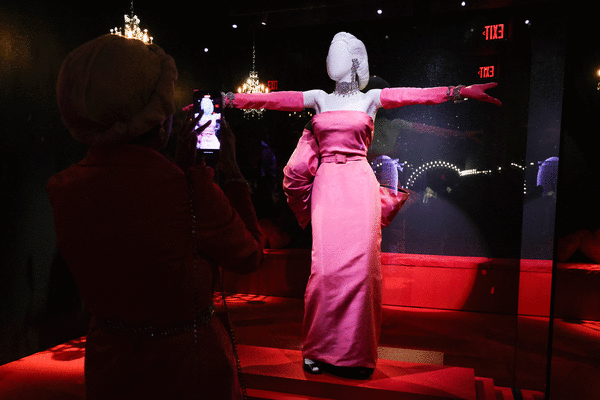
LOS ANGELES — There she stands, in that iconic hot pink gown, arms thrown open wide as if to both offer herself to the world and embrace what the world offers — love, applause, admiration and diamonds, which are, as she sang from the body-hugging confines of that pink silk in "Gentlemen Prefer Blondes," a girl's best friend.
It isn't her, of course, though it is the dress, designed by William Travilla and now a part of the new "Marilyn Monroe: Hollywood Icon" installation at the Academy Museum of Motion Pictures. Opening Sunday, it is just one of many exhibitions and events timed to celebrate the 100th anniversary of Monroe's birth.
More than 60 years after her death, Monroe still glows brightly in the Hollywood firmament. Her career only lasted 17 years, but during that time she dazzled so brightly that her image, and all that has been projected onto it, remains burned into our collective line of vision, an unfading afterimage of a bursting star.
Her death — at 36 by way of overdose — did much to cement her legacy, generating international headlines and then a multitude of conspiracy theories, many of them involving powerful men, including members of the equally mythic Kennedy family.
Tragedy and mystery are powerful binding agents, but they do not quite explain the tower of books that have been, and continue to be, written about her (including several out this year) or the many films made about her life or the art she has inspired, from Andy Warhol's iconic silkscreen "Marilyn Diptych" (done a year after her death) to Seward Johnson's massive statue "Forever Marilyn," which, after some controversy, made its forever home in Palm Springs five years ago.
As the Academy Museum's exhibit underlines, Monroe was a pioneer in many ways. In the repressive '50s, she was sex positive and spoke openly about psychotherapy and the vagaries of fame. She often defied studio heads, was one of the first actresses to start her own production company and demanded approval of her many photo sessions.
She had multiple marriages, problems with drugs and alcohol and a reputation for being difficult on set, but she was unafraid to both call out the press and banter with them.
Still, she is not seen by the masses as a pioneer, a term that brings to mind scientists and suffragettes. No, Monroe remains a mesmerizing, radiant symbol — of beauty, glamour, sensuality, a life force so rare that it could not be expected to survive long in a world full of envy and petty demands.
In putting together "Marilyn Monroe: Hollywood Icon," associate curator Sophia Serrano spoke with many devoted fans, including those whose collections helped build the exhibit, and they all said the same thing.
"Even though she had a tragic ending," Serrano said, "people would say she is a symbol of resilience. Her story is like a movie — an orphan who makes it big, then loses it all. They see her as battling the studio, wanting to get more nuanced roles and not getting the roles she wanted. ... A lot of people latch onto her because she gives them hope."
In many ways, Monroe is, and was, a piece of art herself, onto which we could project our own longings and adulation. But that art, Serrano says, was created by Monroe, with equal parts natural magnetism and a canny, rigorous sense of her own strengths.
In 1952, when she was a rising star, a journalist realized a nude pin-up being used in calendars and posters was Monroe; she had posed for what is now known as the "Golden Dream" series five years before. Monroe was filming 20th Century Fox's "Gentlemen Prefer Blondes" at the time and studio head Darryl Zanuck pressured her to deny that the photos were of her.
Monroe did the exact opposite, shrugging it off in an interview, in which she said, "I was broke and I needed the money. ... I'm not ashamed of it; I've done nothing wrong."
Monroe's unique, and, to a certain extent, self-constructed combination of vulnerability — the wide eyes, the half-open mouth, the child-like voice — and essential grit is what fuels her continued cultural resonance and what forms the guiding principal for the Academy Museum's exhibit.
An exhibit on the life and legacy of Marilyn Monroe could fill an entire museum so for purposes of this exhibit, Serrano and her team chose objects that were relevant to her life. This being the Academy Museum, much of it focuses on her career in film. Costumes from her various movies (including the original exhibition copy of the famous white dress from "The Seven Year Itch") occupy a big portion, in part, Serrano says, because Monroe was so often involved in their design.
"She was so smart, looking at these costumes," Serrano says. "She was obviously Fox's star for Cinemascope — she's how they marketed the new technology and she didn't like how certain silhouettes looked so she would not wear A-lines in Cinemascope because she thought the effect was unflattering. She really paid attention to how things worked and then knew how to control and edit and manage."
The pink gown from "Gentlemen Prefer Blondes" has its own story. Monroe's character was originally to appear in bejeweled hot pants (also on display), but when the Golden Dream "scandal" broke, Zanuck demanded that she wear something less revealing.
Many personal items are on display as well, including the shoes she wore to her wedding to Joe DiMaggio, a rare apology from gossip columnist Hedda Hopper, marked-up scripts and parts of her makeup regimen (including a face-slimming mask she wore after being told she had a double chin). The love-hate relationship she had with the press is well represented by newspaper clippings and newsreels.
A whole room is devoted to scenes from her more famous films and an entire long wall to countless photographs. "She understood the camera better than anyone," Serrano says, echoing observations made by photographers and actors who worked with her, including Laurence Olivier, who famously did not get along with Monroe during the filming of "The Prince and the Showgirl."
Her reputation as being difficult on certain sets is also documented in a rather infuriating series of telegrams between director Billy Wilder complaining to her then-husband, playwright Arthur Miller, and Miller responding in defense of his wife.
It is a well-crafted glimpse at Monroe as a totality, including pieces from her Brentwood home and some of her own clothing, which Serrano says was far simpler than the gowns and suits she was photographed in. "Her persona was carefully constructed. She knew how to give just enough, to create the illusion of something."
And maybe that is the reason why Monroe continues to fascinate. Yes, she owned her beauty and sexuality with a boldness that stands out even now. Her relationship with the camera remains unparalleled — when she is in frame, it is almost impossible to look away. Her hip-swaying walk remains iconic and also, perhaps, revealing. It was achieved by putting one foot directly in front of the other, much like a tight-rope walker.
Which in many ways Monroe was, treading the line, invisible to the rest of us, between innocence and worldliness, between vulnerability and power.
The tension between the human need for both love and self-determination powers both art and madness, but never was it so tangibly brought to life than by Marilyn Monroe. Art and artist, creation and creator, she left behind a now-century-old mystery we're still trying to unravel.
©2026 Los Angeles Times. Visit latimes.com. Distributed by Tribune Content Agency, LLC.










Comments