Dave Hyde: For Jim Larrañaga, teaching didn't end with his coaching career
Published in Basketball
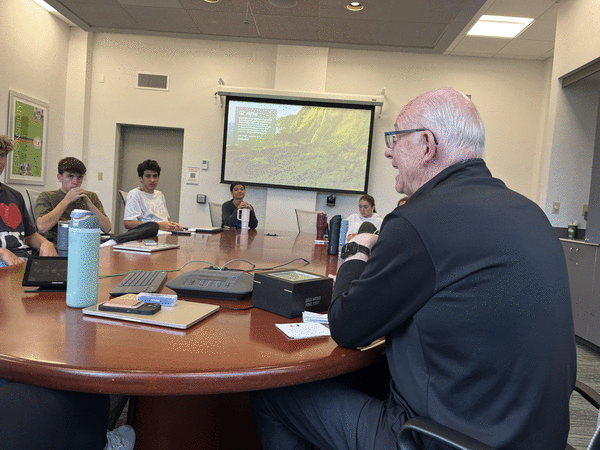
CORAL GABLES, Fla. — On Tuesday morning, a night’s sleep after watching college basketball’s national championship game, the University of Miami professor had students set their watches to 10:15 a.m., as he does every class, and then review motivational author Stephen R. Covey’s “Seven habits of highly effective people.”
“Who can name them?” Jim Larrañaga asked 10 freshman students around a conference table.
For years, these seven habits were written on signs lining the baseline at Miami men’s basketball practices for players to learn. Now Larrañaga stopped a freshman who forgot one and asked the class to help.
“Put first things first,” another student said.
These students are having an educational treat, a one-hour class on leadership each week taught by a master on the subject for five decades in college basketball. Larrañaga’s final 14 seasons were at Miami, where he took teams to the Final Eight and then the Final Four.
As part of Tuesday’s class, Larrañaga had students bring in an “artifact” about their lives to discuss its importance with the class. A religious pendant, framed photos, a track shoe, pajamas — each student had their story. Larrañaga passed around his Final Four ring.
“You see what it’s inscribed in it?” he asks. “Commitment. Attitude. Class. That’s my three-word philosophy. They aren’t just ideas to make someone a better basketball player. They make you a better person.”
Times change. Character doesn’t. Maybe that’s another leadership lesson for the class. Just three years ago, Larrañaga was earning that Final Four ring in a final weekend with Connecticut coach Dan Hurley and Florida Atlantic’s Dusty May.
May and Hurley were back again for Monday’s championship game. May, now coaching Michigan, won the championship to cap his rise.
“He done so much right,’’ Larrañaga said.
Larrañaga, 76, couldn’t make the turn to the NIL Era in college sports. Eight players he’d developed transferred after the Final Four run for money reasons. He made some mistakes picking players. He became exhausted by the process and resigned in December 2024.
“In a certain regard, it was sad,’’ he said. “I never imagined my coaching career ending that way, where I felt that I wasn’t able to do what I had for 50 years. The culture had changed so dramatically.
“You know, when a university hired a coach, they pay him well to win. We had gone deep into the tournament just before that. But I suddenly felt, ‘Whoa, we’re not in the right place.’ I had to look myself in the mirror and say I wasn’t the right coach to lead the university.”
Jai Lucas became the right coach for Miami, as his national coach of the year award showed this season. But Larrañaga wanted to make something good from that bad finish. He talked to university officials about helping in fundraising and teaching a class.
That’s why he was at the table with students on Tuesday. He always considered himself a teacher — an educator, actually considering that idea is to help prepare someone for life. Just this week a former Miami player, Tonye Jekiri, who is finishing a 10-year pro career in Serbia, called Larrañaga about talking with a school administrator for his next career.
Larrañaga set Jekiri up, just as he did Sarah Algate, a freshman in his class who asked about inroads into a sports marketing internship at the school. She didn’t know what to expect.
“The next week we met, he had a person for me to call,’’ Algate said. “He didn’t have to do that. But he did, and it was such a big help for me.”
At 10:15 a.m., the students’ phone alarms buzzed. This last stretch of class consists each week of students interacting with another student they haven’t met.
“Communication,’’ Larrañaga said, “is the key to teamwork.”
Sometimes, sports isn’t about a score or even a game. It’s a life that doesn’t end at the court — or even with a career. Larrañaga always said he would coach as long as he could, because he had no hobbies like golf or fishing. But he has a hobby.
As he leaves class, backpack on, he says, “I’ve always liked to teach.”
____
©2026 South Florida Sun-Sentinel. Visit sun-sentinel.com. Distributed by Tribune Content Agency, LLC.






Comments